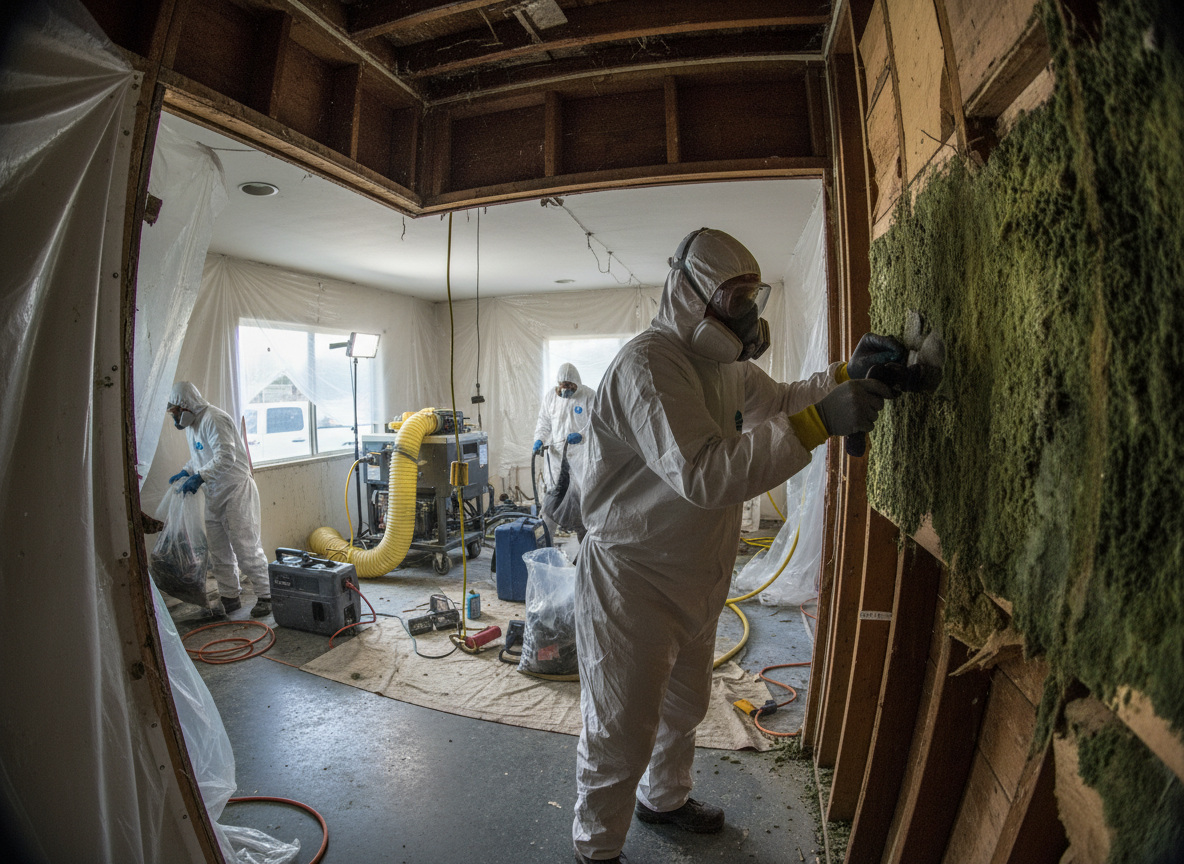
Mira Loma's hot desert climate with extreme summer heat drives heavy air conditioning use that often leads to hidden condensation in wall cavities and attics of homes built before 2000. These conditions promote toxic mold growth behind drywall and in crawlspaces, especially in Downtown Mira Loma neighborhoods where older single-family homes sit on slabs or raised foundations. Standard visual checks miss these colonies, requiring moisture mapping and air sampling to locate the source before any removal begins.
Containment becomes critical in Riverside County properties because the dry air outside can spread spores quickly once disturbed. Technicians set up negative air machines with HEPA filtration and seal off HVAC systems to prevent cross-contamination into living spaces. In homes near Wine Country or bordering Jurupa Valley and Eastvale, irrigation runoff from nearby vineyards or yards frequently saturates soil against foundations, creating recurring moisture that demands both removal and long-term drainage fixes.
Clearance testing after toxic mold removal verifies spore counts return to normal outdoor baselines, a step required before any reconstruction. Materials like porous insulation and baseboards are discarded rather than cleaned when black mold or stachybotrys is confirmed. Owners in Ontario and Eastvale often discover the issue only after musty odors appear during the first heat wave, when AC systems run nonstop and push spores through ducts.
Technician insight
In Mira Loma, the thing that catches most people out with toxic mold removal is how constant summer AC use in pre-2000 homes creates condensation behind the drywall even when the desert air outside stays bone dry, especially in Downtown Mira Loma houses where slab edges meet irrigated yards.
Hidden Growth After Irrigation Leak
A homeowner near Mira Loma Park noticed a persistent musty smell during a heat wave. Inspection revealed stachybotrys behind baseboards where lawn irrigation had soaked the foundation over years. Crews contained the bedroom, removed the affected drywall and insulation, dried the cavity, and cleared the space with air testing before reconstruction.
How it works
- 1
Initial Assessment
Technicians arrive within hours to inspect affected areas using moisture meters and borescopes in attics, walls, and crawlspaces common to Mira Loma homes.
- 2
Containment Setup
Plastic barriers and negative air pressure isolate the work zone to stop spore migration through the HVAC systems typical in local single-story houses.
- 3
Removal and Disposal
Contaminated drywall, insulation, and baseboards are cut out and bagged for proper disposal while HEPA vacuums capture remaining particles.
- 4
Drying and Clearance
Industrial dehumidifiers and air movers dry the structure, followed by post-remediation air sampling to confirm levels match outdoor conditions.
Pricing
Cost depends on square footage affected, depth of hidden growth, and whether HVAC cleaning is needed; upfront quotes provided after inspection.