Mira Loma's hot desert climate drives attic temperatures well above 130 degrees in summer, creating rapid moisture evaporation followed by condensation once evening cools the roof deck. This pattern commonly affects homes in Downtown Mira Loma and nearby Jurupa Valley where older roof vents and minimal insulation allow humid air to linger. Technicians must time testing after sunset or use moisture meters that account for thermal mass in rafters to avoid missing active growth sites hidden behind fiberglass batts.
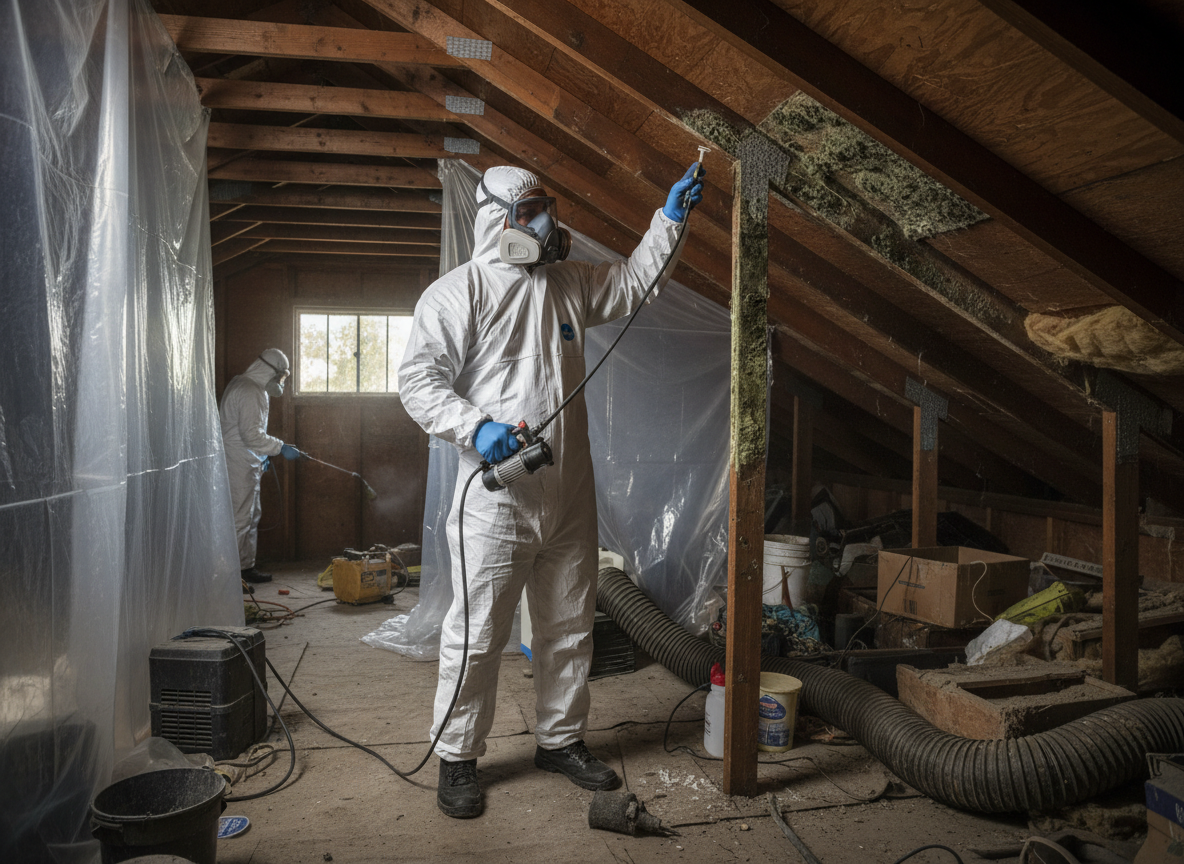
Single-story ranch homes common across Riverside County near Eastvale and Ontario often route HVAC ducts through attics, so any disturbance during removal risks pulling spores into living spaces. Testing protocols include surface swabs from sheathing, air sampling at multiple elevations, and checks around penetrations where plumbing or electrical lines enter from below. Containment uses sealed poly barriers and negative air machines exhausted through roof jacks to prevent cross-contamination into adjacent bedrooms.
Roof leaks from thermal expansion in extreme heat frequently start at flashing around skylights or vents in Wine Country-adjacent neighborhoods. Removal requires cutting out affected OSB or drywall sections while preserving structural integrity, followed by HEPA vacuuming and antimicrobial treatment on remaining wood. Post-remediation clearance testing verifies spore counts match outdoor baselines before insulation is replaced and ventilation is upgraded to handle Mira Loma's seasonal temperature swings.
Technician insight
In Mira Loma, the thing that catches most people out with Attic mold testing and removal is how the extreme summer heat bakes moisture out of visible surfaces during the day, only for condensation to reappear at night in older homes near Downtown Mira Loma where roof vents are undersized and insulation has settled.
Hidden Growth After Roof Repair
Problem: Musty odor appeared in an Eastvale-border home after summer roof work. What we found: Mold colonies behind settled insulation where a small flashing leak had gone unnoticed in the intense attic heat. What we did: Tested multiple zones, contained the space, removed affected materials, and added ridge venting suited to desert conditions. Outcome: Clearance passed and the odor did not return.
How it works
- 1
Initial Assessment
Inspect attic access points, insulation condition, and visible water stains while noting roof age and ventilation setup typical in Mira Loma homes.
- 2
Testing and Sampling
Collect air and surface samples from multiple attic zones, including around ducts and near the Mira Loma Park vicinity where older homes predominate.
- 3
Containment and Removal
Establish negative air pressure, remove contaminated materials, and clean remaining surfaces without disturbing spores into the living area below.
- 4
Verification and Prevention
Perform clearance testing, address moisture sources, and recommend ventilation upgrades suited to Riverside County's hot summers.
Pricing
Costs depend on attic size, extent of hidden growth, and access difficulty; upfront quotes provided after inspection.